| |
 |
|
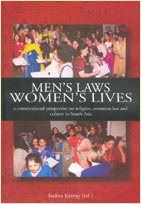
MEN’S LAWS, WOMEN’S LIVES: A CONSTITUTIONAL PERSPECTIVE ON RELIGION, COMMON LAW AND CULTURE IN SOUTH ASIA
Indira Jaising (Ed.)
Rs 500 Hb 2005
81-88965-07-3
(All rights available)
|
|
For about half a century now, South Asia has enjoyed independence and constitutional rule, but many countries have inherited a plural legal system as a legacy of colonialism. In all five countries of the region constitutional guarantees of equality and non-discrimination are confounded by discriminatory personal laws that institutionalise gender inequality.
Contributors to this volume address this problem from the perspective of countries that are statedly democratic and secular, as well as those that are theocratic, and from the experience of maintaining plural legal systems. Specifically, the questions they pose are: has the adoption of secular constitutions in these countries, with guaranteed human rights, made any difference to the legal status of women? What impact, if any, does the adoption of a secular constitution have on the regime of personal laws? Has the transition from colonialism
to constitutionalism in the era of human rights made any difference to the rights of women? Has the adoption of constitutions that recognise equal rights made any difference to the institutionalised private/public divide?
CONTRIBUTORS: Archana Parashar • Cassandra Balchin • Catharine MacKinnon • Faustina Pereira • Indira Jaising • Jeff Redding • Martha C. Nussbaum • Pratap Bhanu Mehta • Radhika Coomaraswamy • Ramani Muttetuwegama • Salma Sobhan • Sara Hossain • Savitri Goonesekere • Sharan Parmar • Zoya Hasan.
|
|
INDIRA JAISING
is Executive Director of Lawyers' Collective Women's Rights Initiative. She was the first woman to be designated Senior Advocate (1986) and the first woman to be appointed Additional Solicitor General of India (2009). Throughout her legal career, Jaising has focused on the protection of the human rights of women, successfully defending several landmark cases on discrimination. She was the recipient of the Padma Shri, the third highest civilian award in India, in 2005, and was nominated to the CEDAW Committee in January 2009. |
|